

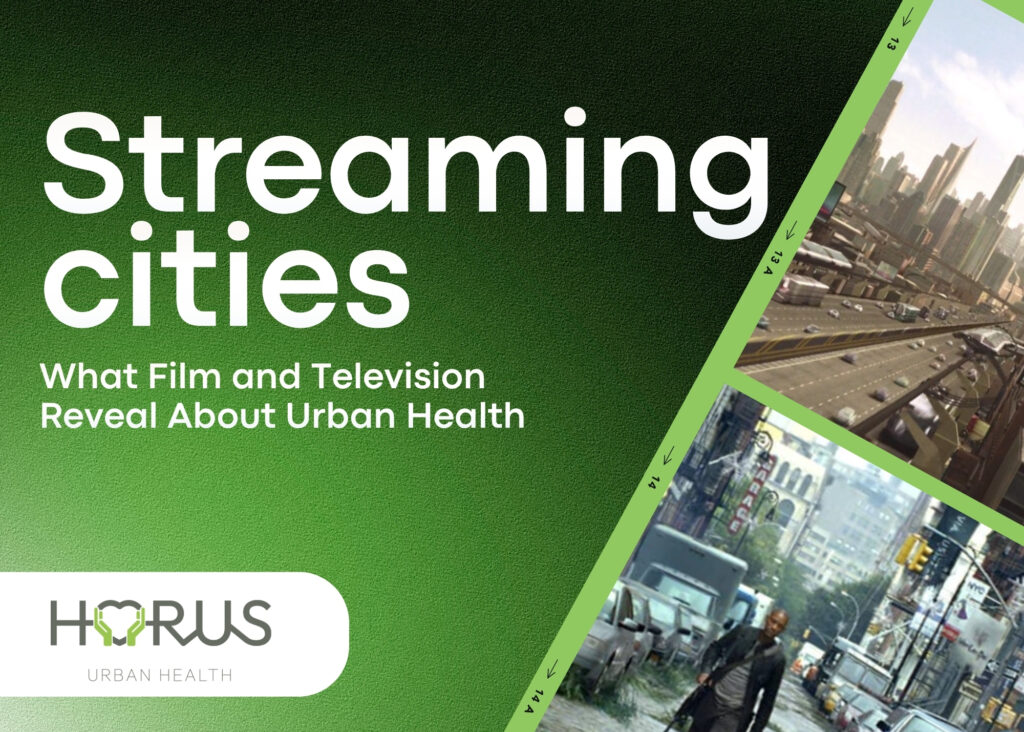
There was a time when conversations about urbanism, public health, and infrastructure belonged almost exclusively to architects, planners, and policymakers. Today, those same conversations unfold through streaming platforms, television series, science fiction universes, and blockbuster cinema. The pace of content and discussion skyrocketed however, space must be found for reflection seizing new formats. We no longer consume stories occasionally or ceremonially; we inhabit them continuously. Series accompany daily life in fragmented episodes watched on trains, in bed, during commutes, or between meetings. Cinema and television have become emotional environments through which we collectively imagine the future.
This transformation matters because culture has become one of the most influential ways contemporary societies process fear, anxiety, and hope. The future of cities is no longer discussed only in conferences or policy papers. It is dramatized in dystopian landscapes, abandoned subway tunnels, vertical megacities, and collapsing infrastructures. Fiction has become a rehearsal space where societies test scenarios before they arrive in reality.
Projects such as HORUS Urban Health emerge precisely at this intersection between technical knowledge and human experience. Urban health cannot be reduced to statistics about pollution, transportation efficiency, or walkability indexes. Cities are emotional ecosystems. They shape loneliness, belonging, vulnerability, trust, movement, and memory. A healthy city is not merely one that functions efficiently; it is one that allows people to live meaningful, connected, dignified lives.
This is why contemporary films and series are so revealing. They expose not only how cities work, but how they feel about them now and our expectations about the future, shaping the way we think. They reveal what happens when infrastructure ceases to support collective life and what remains when social systems begin to fracture. Beneath their entertainment value lies a deeper question: what kind of human beings are our cities producing? Are our cities sustainable anymore in their current form? What changes should we implement?
Civilization After Infrastructure: Fallout, The Last of Us, and Mad Max: Fury Road
Few contemporary films and series explore the fragility of urban civilization as powerfully as Fallout, The Last of Us, and Mad Max: Fury Road. Although each imagines a different apocalypse, all three revolve around the same unsettling idea: cities are not sustained by infrastructure alone, but by trust, cooperation, and collective care.
In Fallout, modern systems have almost entirely collapsed. Transportation networks, healthcare, institutions, and energy grids no longer function. The contrast between the underground vaults and the devastated surface world reveals two extremes of urban life: controlled isolation for a privileged minority and abandonment for everyone else. Beneath its retrofuturistic aesthetics, the series asks a deeply contemporary question: what happens when innovation and security are reserved only for a few while the majority remains vulnerable?
The Last of Us approaches collapse more quietly and emotionally. Nature slowly reclaims highways, malls, and transit systems, transforming cities into empty shells of collective life. Roads still exist, but no longer connect communities. Hospitals remain standing, but healthcare systems have disappeared. The real tragedy of the series is not infection itself, but loneliness. Urban life depends on encounter, trust, and shared public space. When fear destroys those connections, the city loses its meaning.
In Mad Max: Fury Road, the collapse becomes total. Mobility no longer represents freedom, but violence and domination. Vehicles become weapons, fuel becomes power, and public life disappears almost entirely. There are no civic institutions or places of encounter left — only extraction, scarcity, and survival. The film functions as an extreme metaphor for urban systems built entirely around competition and resource control.
Taken together, these stories are not simply dystopian fantasies. They reflect contemporary anxieties already visible in our own cities: inequality, privatization, climate vulnerability, isolation, and the erosion of public trust. They remind us that infrastructure without solidarity ultimately leads either to wastelands or to vaults built out of fear.

Community and the Emotional Life of Cities: Andor, Severance, and Children of Men
Among recent science fiction productions, Andor offers one of the richest portrayals of urban life and collective identity. Unlike many futuristic narratives obsessed with spectacle and technology, the series focuses on ordinary people and the environments they inhabit together. The industrial town of Ferrix is dense, walkable, noisy, imperfect, and profoundly human. People repair objects rather than discard them. Labor remains visible. Streets encourage interaction, rituals persist, and public space still belongs to the community. Ferrix feels alive because its infrastructure supports relationships rather than control. The series suggests that healthy urban environments emerge not from perfection or technological sophistication, but from solidarity, shared responsibility, and emotional investment in collective life.
Severance presents the opposite vision. Its office interiors are clinically ordered, endlessly repetitive, and psychologically oppressive. Corridors stretch without meaning, and rooms feel detached from reality itself. The environment appears designed not for human flourishing, but for behavioral control and productivity. What makes the series especially unsettling is the way architecture fragments identity: characters become literally divided between their work selves and personal selves. From the perspective of urban health, Severance exposes how contemporary environments increasingly prioritize efficiency, surveillance, and performance while neglecting emotional needs such as belonging, autonomy, and care.
In Children of Men, the city becomes an atmosphere of collective despair. Streets are militarized, refugees are treated as threats, and institutions continue functioning despite having lost moral legitimacy. The film portrays urban collapse not through ruined buildings, but through the disappearance of trust. Once societies stop believing in a shared future, public life begins to fracture from within. Together, these works reveal that the true health of a city depends not only on infrastructure or technology, but on whether people still feel connected to one another and capable of imagining a common future together.

Addiction, Isolation, and the City as a System of Habits: The Wire, Requiem for a Dream, and Her
Few works of film and television have explored the relationship between cities, emotional wellbeing, and destructive habits as powerfully as The Wire, Requiem for a Dream, and Her. Although very different in tone and aesthetics, all three ultimately reveal the same unsettling truth: urban health is never only about infrastructure, medicine, or technology. It is about whether cities create the conditions in which human beings can sustain dignity, connection, and hope — or whether they quietly normalize isolation, anxiety, and despair as part of everyday life.
In The Wire, addiction emerges from structural inequality. Abandoned neighborhoods, underfunded schools, inaccessible healthcare, economic exclusion, and the erosion of public trust create environments where drugs become embedded within the social fabric of the city. Corners function as informal economies because formal systems have already failed entire communities. The series refuses to portray addiction as an individual moral weakness. Instead, it suggests that unhealthy habits are often symptoms of unhealthy urban conditions. When cities stop offering stability, opportunity, or collective care, addiction becomes both escape and inherited reality.
Requiem for a Dream approaches the same issue from a more intimate and psychological perspective. Darren Aronofsky portrays addiction not only through narcotics, but through television, body image, consumption, and the desperate search for recognition. Its urban environment feels emotionally claustrophobic despite its density. Characters are surrounded by noise, advertising, stimulation, and media saturation, yet remain profoundly disconnected from one another. The city constantly produces desire while offering almost no meaningful forms of connection in return. Addiction becomes less about substances themselves and more about filling emotional voids left by loneliness and social fragmentation.
If The Wire exposes the structural side of urban despair and Requiem for a Dream reveals its psychological dimension, Her presents perhaps the most subtle and contemporary version of the same crisis. Unlike traditional dystopias, the city in Her appears calm, elegant, efficient, and highly livable. Streets are clean, public transportation functions smoothly, and urban density feels balanced rather than oppressive. Yet beneath this visual harmony lies profound emotional solitude. The protagonist moves through a city full of people while remaining fundamentally disconnected from them. Technology enables constant communication, but increasingly replaces intimacy itself.
What makes Her especially relevant to contemporary urban health is its understanding that loneliness is not merely an individual condition, but also a spatial and cultural one. Cities can facilitate encounter, community, and emotional presence — or they can quietly intensify isolation despite functioning perfectly on a technical level. The film reminds us that efficient infrastructure alone does not create healthy urban life. Human wellbeing also depends on opportunities for genuine connection, shared public space, and emotional belonging.
Taken together, these works reveal that destructive habits, addiction, loneliness, and emotional exhaustion rarely emerge independently from the environments people inhabit every day. Cities shape mental health through housing, mobility, economic security, public space, access to community, and social trust. When these systems deteriorate, people often seek substitutes for the forms of care and belonging that urban life no longer provides. In that sense, the greatest urban health challenge of contemporary cities may not simply be pollution, congestion, or infrastructure failure, but the slow normalization of emotional isolation in environments increasingly unable to sustain collective human connection.

Why Stories Matter for HORUS and Urban Health Discussions
The worlds imagined by contemporary cinema and television are often exaggerated, dystopian, or speculative. Yet their emotional power comes from the fact that they recognize something deeply real about modern urban life.
They reveal collective fears surrounding loneliness, technological dependence, environmental collapse, and social fragmentation, in all the city becoming something different that a place for humans to live well. They also reveal enduring human desires for connection, health, safety, dignity, and belonging.
Projects such as HORUS Urban Health operate precisely within this tension. The future of cities will not be shaped only by data, sensors, or engineering solutions. Those must be just side contributors for a well planned city. It will also depend on how human societies imagine themselves living together.
In this sense, stories matter because they teach us how cities feel before they become reality. And perhaps that is the most important lesson these films and series offer: urban health is not ultimately about infrastructure. It is about protecting the conditions that allow human beings to remain human in the spaces they share together as green spaces, walkability, healthy habits and all that makes a city a good place to live.