
Rethinking Urban Health
Non-communicable diseases (NCDs) remain one of the leading public health challenges worldwide, driven by a complex combination of behavioural, environmental and social factors. In urban contexts, these challenges are particularly pronounced, as cities shape how people move, eat, interact and access health-supporting resources.
Addressing NCD risk factors therefore requires going beyond individual behaviour change and understanding the broader systems that influence everyday life. From transport infrastructure and food environments to community dynamics and access to green spaces, urban settings play a critical role in shaping health outcomes across populations.
In response to this challenge, several Horizon Europe projects are working to design, implement and evaluate innovative approaches to urban health. Projects such as HORUS, ENABLE, ChangeMaker and CityMove are exploring how context-adapted, evidence-based and participatory interventions can support healthier lifestyles and reduce NCD risk factors in diverse settings.
This joint webinar brings these projects together to share insights, exchange experiences and reflect on how to design more effective, scalable and equitable urban health interventions.
What is the webinar about?
This cluster webinar will focus on project presentations, results, best practices and lessons learned, followed by an interactive Q&A session.
During the session, each project will present its work by introducing its consortium and objectives, as well as the target groups and settings in which the interventions are being implemented. The presentations will also explore the types of interventions developed, including the use of digital tools or platforms where relevant, and will reflect on expected outcomes and potential impact.
By offering a comprehensive yet accessible overview of each initiative, the webinar will highlight both shared approaches and context-specific solutions to urban health challenges. Dedicated Q&A segments after each presentation will allow participants to engage directly with project representatives, fostering exchange and discussion around key lessons learned and future opportunities.
The webinar will be recorded and made available for dissemination purposes.
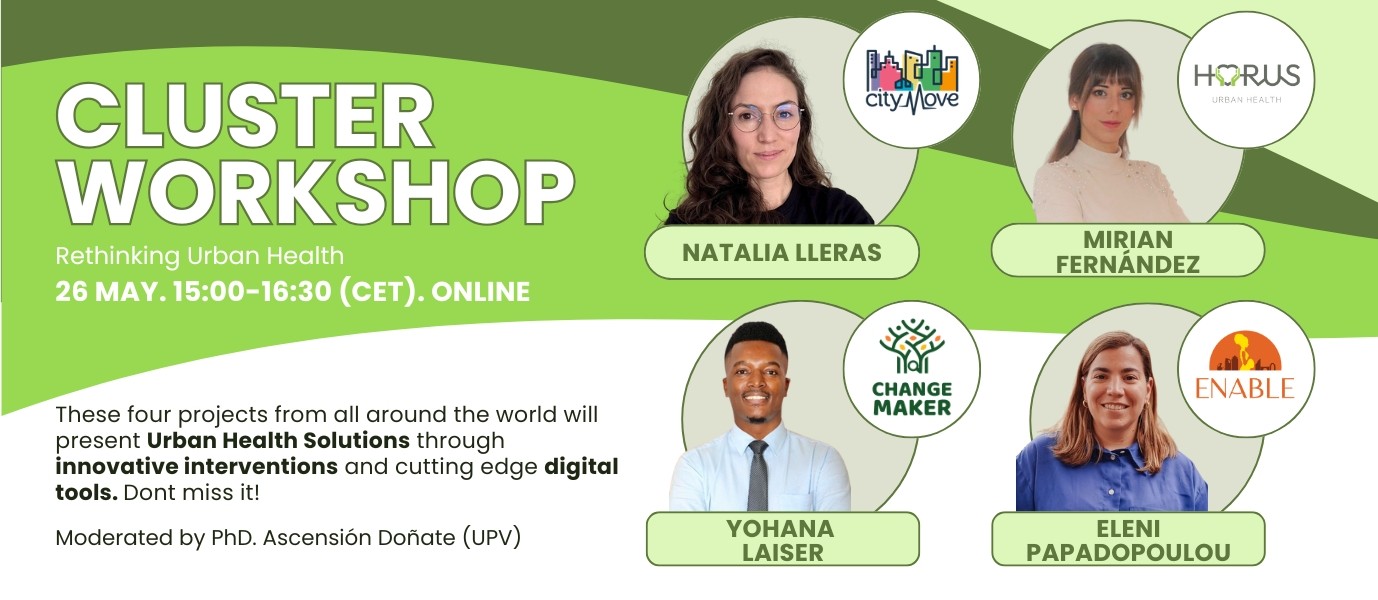
Date: 26 May 2026 (15:00-16:30)
Duration: 90 minutes
Format: Online
Agenda
0:00 – Welcome and cluster introduction
Project presentations + Q&A:
- 0:05 – Changemaker presentation + 5 min Q&A
- 0:25 – CityMove presentation + 5 min Q&A
- 0:45 – ENABLE presentation + 5 min Q&A
- 0:65 – HORUS presentation + 5 min Q&A
0:85 – Round-up discussion
0:90 – Closing
Registration
Register here: https://forms.office.com/e/ktKqCPDm5E
Participants
HORUS
HORUS focuses on understanding how urban environments influence health behaviours and the development of non-communicable diseases (NCDs), with a particular emphasis on vulnerable populations.
The project adopts a systemic approach to urban health, combining behavioural science, urban planning and public health to design and implement interventions that promote healthier lifestyles. Through its pilot cities —Valencia, Rijeka and Rotterdam— HORUS works in real-life contexts to analyse how factors such as the built environment, mobility patterns and social conditions shape everyday behaviours related to physical activity, diet and wellbeing.
By integrating research, community engagement and evidence-based interventions, HORUS aims to generate actionable insights that can support more effective urban policies and contribute to the creation of healthier and more equitable cities.

Speaker: Mirian Fernández Salido
Mirian Fernández Salido is a postdoctoral researcher at the Institute for Social Welfare Policy Research (Polibienestar) at the University of Valencia. She holds a PhD in Design, Management and Evaluation of Public Policies, with a research focus on integrated health and social care systems, ageing, and value-based care models.
Her work centres on improving coordination between health and social services, enhancing quality of life for older adults, and evaluating the efficiency and sustainability of person-centred care approaches. She has been involved in several European projects, including VALUECARE (Horizon 2020), where her doctoral research examined innovative policies supporting informal caregivers and the implementation of value-based care models.
Mirian has published in high-impact scientific journals in the fields of public health, social care and welfare policy. Currently, she contributes to the design, implementation and evaluation of European projects focused on innovation in health and social systems, with a strong emphasis on evidence-based policymaking and knowledge transfer.
ENABLE
ENABLE aims to reduce the burden of non-communicable diseases (NCDs) by addressing key risk factors among pregnant women in urban Ethiopia. The project promotes healthy diets, physical activity and reduced exposure to air pollution through context-adapted, evidence-based interventions implemented in cities such as Addis Ababa, Adama, Harar and Jimma.
Speaker: Eleni Papadopoulou
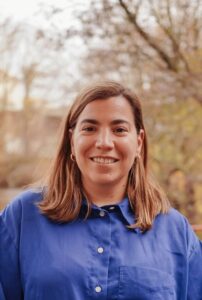
Eleni Papadopoulou, PhD, is a Research Professor and epidemiologist at the Norwegian Institute of Public Health (NIPH) in Oslo. She coordinates the EU-funded ENABLE project and has a background in nutrition and public health, with expertise in environmental epidemiology. Her work focuses on the impact of environmental exposures during pregnancy and early life, as well as strengthening health systems and research capacity in low- and middle-income countries.
ChangeMaker
The ChangeMaker project focuses on promoting co-designed, sustainable health interventions with adolescents to reduce the risk of non-communicable diseases (NCDs) in rapidly urbanising African cities such as Ouagadougou, Kisumu and Dar es Salaam.
Through a whole-systems approach, the project combines urban farming, health education, counselling and media campaigns, engaging young people and local stakeholders in the co-design of interventions tailored to their specific contexts.

Speaker: Yohana Laiser
Yohana Laiser is a trained Medical Doctor and a Research Program Officer at Africa Academy for Public Health (AAPH), where he contributes to advancing adolescent health through research in Tanzania and across sub-Saharan Africa. In the Changemaker Project, he has taken lead at the Tanzania sites in co-designing the study interventions through participatory approaches with adolescents, teachers and community stakeholders. His coordination efforts and wholistic stakeholder engagement has focused on refining implementation strategies and curating activities’ sequences for the trial phase. Boots hit the ground earlier this year for the planned Changemaker trials in Dar es Salaam Secondary Schools with Dr. Laiser centrally facilitating research teams, ensuring ethical conduct and catalysing adolescent-centred operational processes.
CityMove
CityMove (City-based actions to stimulate active Movement for health) focuses on addressing one of the key challenges of urban living: insufficient physical activity and its impact on health.
Across many cities worldwide, sedentary lifestyles, unhealthy diets and poor air quality are contributing to the rise of non-communicable diseases (NCDs), including cardiovascular diseases, respiratory conditions and diabetes. CityMove aims to better understand how urban environments can support more active and healthier lifestyles, particularly among less active or vulnerable populations.
The project brings together 9 organisations and over 50 international researchers to study the impact of 13 physical activity interventions across six cities in Europe, Africa and Latin America. By aligning with the WHO Global Action Plan on Physical Activity (GAPPA), CityMove also seeks to develop a framework to assess the transferability and scalability of successful actions across different contexts.

Speaker: Natalia Lleras
Natalia is an expert in creating of sustainable, safe, active, and gender-responsive environments. She is the Programme Manager and Latin America and the Caribbean Lead at Walk21 Foundation, bringing over 10 years of experience in leading urban health initiatives. Natalia also supports governments in adopting walking and cycling solutions through public policy development, participatory planning, safe street design, and applied research.
Conclusion
Urban health challenges require collaborative, cross-sectoral and context-sensitive approaches. By bringing together different projects, perspectives and experiences, this webinar aims to contribute to a shared understanding of what works, what doesn’t, and how interventions can be scaled and adapted across settings.
Join us to explore how research, practice and collaboration can help shape healthier urban environments and reduce the burden of NCDs.